
AI Takes Log Measurement to the Next Level
Mabema is shaping the future of GPV – powered by AI and a passion for image processing.
Splitting a log pile may sound simple. But achieving completely accurate volume calculations requires the system to pinpoint exactly where the pile should be divided. That’s where Mabema’s latest AI initiative comes into play.
Leading this work is Michael Nilsson, software engineer at Mabema. He is one of the driving forces behind the journey toward full automation – combining deep technical expertise with a curiosity that rarely settles for “good enough”.


Michael holds an MSc in Biomedical Engineering from Linköping University, but it was image processing that captured his interest early on.
In his master’s thesis, he trained AI models to segment road networks in satellite images, and at Saab he worked on interpreting terrain in sonar data – experiences that now form the foundation of his work at Mabema.
At its core, this involves teaching AI to understand an image, pixel by pixel, and recognise patterns that are difficult for the human eye to detect. The technique used, semantic segmentation, is particularly powerful when high precision is required in complex imagery.
The Cerise Line That Set a New Standard
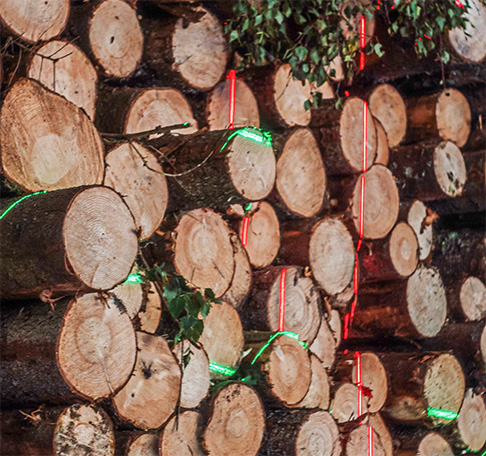
To identify a log pile division, truck drivers mark a line on the load. A division may be needed for several reasons – for example, different assortments stacked together or deliveries to different buyers. Precision is crucial.
It was Mabema who established the standard after extensive testing, determining that a cerise-coloured line provides the best contrast in the image. Previously many colours were used, but today most drivers choose this exact shade.
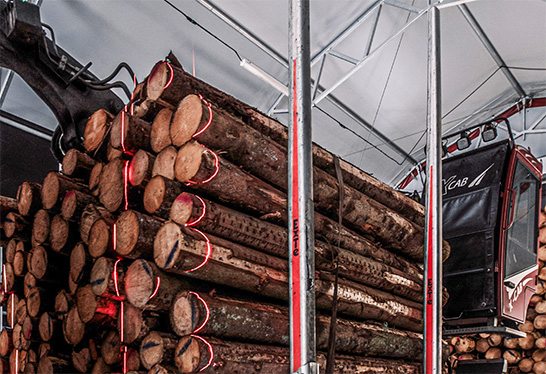
With AI, the system can now locate the line with high precision, even with variations in lighting or image quality, and calculate the volume of each section of the pile with exceptional accuracy.
Where classical image processing achieved around 85% reliability in finding the line, Mabema’s AI now detects it every time – and can even determine the precise break point between two logs. This ability to find the transition point is a new level of accuracy and essential for fully reliable volume calculations.
Every Log Pile Is Unique
What fascinates Michael most is the variation in the material itself. He describes it as logs being like snowflakes, and piles like snowdrifts – each one unique.
By identifying exactly where the division lies, Mabema’s GPV calculates the true volume for each section, rather than relying on averages. This eliminates the need for manual corrections at measurement stations and significantly reduces operational costs.
The Drive Behind the Development
Outside Mabema, Michael is a father of young children in Linköping – but his passion for image processing is always present. He enjoys understanding why something works and how it can be improved. That mindset makes the work both challenging and rewarding.
With Mabema’s AI initiative, GPV has taken another important step toward the goal of full automation within two years. The team has now reached – and surpassed – the target for log pile division accuracy, but the development continues. The more they learn, the more opportunities they uncover.
👉 Want to know more about Mabema’s AI initiative and GPV?
Contact us: mabema.com/en/contact